Scrolling Yourself Sick: What Your Instagram Feed Is Really Doing to Your Brain
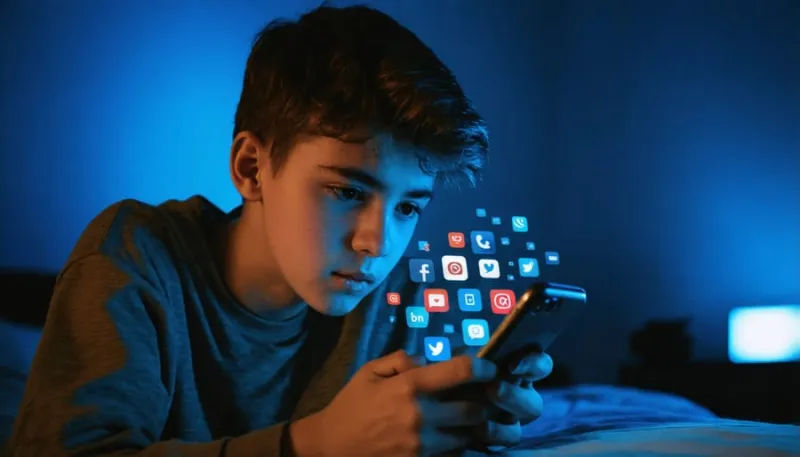
Photo: person looking stressed at smartphone social media scrolling, via www.kidsmentalhealth.ca
You're Not Imagining It — The Scroll Really Is Messing With You
You open Instagram to kill five minutes while waiting for your coffee. Forty-five minutes later, you surface feeling vaguely awful — like you haven't done enough, earned enough, or become enough. Sound familiar? You're not weak, and you're not alone. What you're experiencing has a name, a mechanism, and — here's the good news — a fix.
Social comparison isn't a modern invention. Psychologist Leon Festinger identified it back in 1954, arguing that humans have a built-in drive to evaluate themselves by measuring up against others. For most of human history, that meant comparing yourself to your neighbors, coworkers, or the people you actually knew. Now? You're stacked up against thousands of strangers daily, many of whom are professionally lit, filtered, and carefully curated to look aspirational. That's a game your nervous system was never designed to play — and it's losing.
The Psychological Mechanics Behind the Spiral
Here's what's going on under the hood. When you scroll past someone's promotion announcement, their Tulum vacation, or their impossibly organized pantry, your brain registers a gap between their life and yours. Researchers call this upward social comparison, and while it can occasionally motivate, chronic exposure does something far more damaging: it rewires your baseline for what "normal" looks like.
Over time, that distorted baseline fuels three specific mental health patterns that therapists are seeing more and more in their US adult clients:
Anxiety. The constant stream of achievement and beauty creates an ambient pressure — a low-grade hum of not enough that follows you off the app and into your actual life.
Impostor syndrome. When everyone online appears confident, successful, and thriving, your own private doubts start to feel like proof that you're the only one faking it. You're not. You're just seeing everyone else's front door while they see yours.
Perfectionism. Curated feeds set a visual and lifestyle standard that doesn't exist in real life. Chasing it doesn't produce excellence — it produces paralysis, procrastination, and burnout.
A 2022 study published in the Journal of Social and Clinical Psychology found that limiting social media use to 30 minutes per day led to significant reductions in loneliness and depression in young adults. Thirty minutes. That's less time than most people spend scrolling before bed.
Why "Just Log Off" Isn't the Whole Answer
You've probably told yourself to use your phone less. Maybe you've deleted apps, set screen time limits, or gone on a digital detox that lasted about four days. The reason those efforts fizzle isn't willpower — it's that they treat the symptom without touching the root.
Social media fills a psychological need. Usually it's connection, validation, boredom relief, or a sense of belonging. If you yank the app away without addressing the underlying need, you'll either reinstall it by Thursday or find another numbing habit to replace it. The real work is figuring out what the scroll is doing for you — and then meeting that need in a way that doesn't leave you feeling hollowed out.
Practical Strategies That Actually Hold Up
Do a values audit, not just a feed audit. Before you unfollow anyone, spend ten minutes writing down what actually matters to you — your relationships, your creative work, your health, your community. Then look at your feed through that lens. Does what you're consuming reflect those values, or is it quietly undermining them?
Curate aggressively and without guilt. Unfollow, mute, and restrict freely. This isn't about being petty — it's about protecting your mental environment the same way you'd protect your physical one. You wouldn't fill your living room with things that made you feel bad. Your feed deserves the same standard.
Introduce friction. Log out of apps after each session so re-entering requires effort. Move social apps off your home screen. Charge your phone outside your bedroom. These small barriers won't eliminate the urge to scroll, but they interrupt the autopilot loop long enough for your prefrontal cortex to catch up.
Practice the "real life" pause. When you feel the comparison spiral starting, try this: close the app and name three things happening in your actual, physical life right now. Not aspirational things — just real ones. The smell of your coffee. The sound outside your window. Your own breathing. This isn't spiritual bypassing; it's neurological pattern interruption.
Replace passive consumption with active creation. Scrolling is passive; it puts you in the audience of other people's lives. Creating — even something small, even something nobody sees — puts you back in the driver's seat of your own. Write a paragraph. Cook something new. Send a voice memo to a friend. The energy is completely different.
Redefining What "Connected" Actually Means
Here's the reframe that tends to land hardest: social media platforms are not connection — they're about connection. The real thing happens in DMs, in phone calls, in sitting across from someone at a diner booth. When you mistake the performance of a life for the life itself, you end up feeling lonelier the more you scroll, not less.
A carefree fresh start doesn't mean abandoning technology. It means refusing to let technology set the terms of your self-worth. You get to decide what your life looks like — not by comparison to a stranger's carefully staged kitchen, but by what actually makes you feel alive, rested, and like yourself.
The feed will always be there. Your mental peace is worth protecting first.
Small Shifts, Lasting Change
You don't have to overhaul your entire digital life by next Monday. Start with one thing: pick a 30-minute window today where your phone stays face-down. Notice what comes up — restlessness, relief, boredom, creativity. Whatever shows up is information.
That information is the beginning of something better than a perfectly curated feed. It's the beginning of an honest relationship with your own life — messy, unfiltered, and genuinely yours.